


Setembro, 2025
DOI: 10.48550/arXiv.2509.16893
Proceedings of the 2025 Conference on Empirical Methods in Natural Language Processing
Farhangian, F., Ensina, L. A., Cavalcanti, G. D., & Cruz, R. M. (2025, November). DRES: Fake news detection by dynamic representation and ensemble selection. In Proceedings of the 2025 Conference on Empirical Methods in Natural Language Processing (pp. 20034-20052). https://doi.org/10.48550/arXiv.2509.16893
Abstract
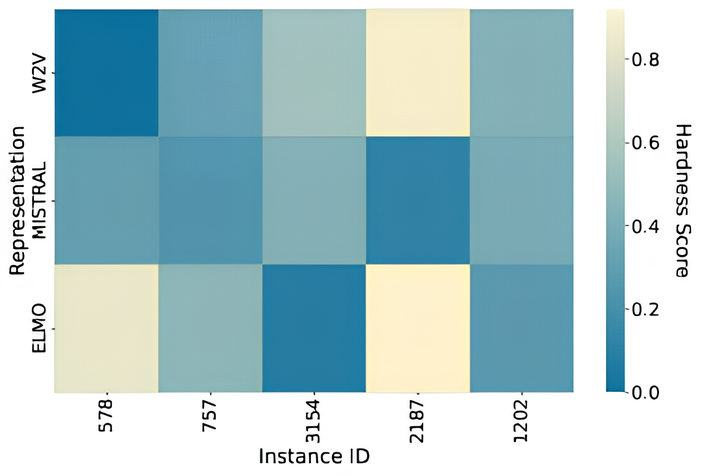
The rapid spread of information via social media has made text-based fake news detection critically important due to its societal impact. This paper presents a novel detection method called Dynamic Representation and Ensemble Selection (DRES) for identifying fake news based solely on text. DRES leverages instance hardness measures to estimate the classification difficulty for each news article across multiple textual feature representations. By dynamically selecting the textual representation and the most competent ensemble of classifiers for each instance, DRES significantly enhances prediction accuracy. Extensive experiments show that DRES achieves notable improvements over state-of-the-art methods, confirming the effectiveness of representation selection based on instance hardness and dynamic ensemble selection in boosting performance. Codes and data are available at: https://github.com/FFarhangian/FakeNewsDetection_DRES.
Authors
Faramarz Farhangian, LIVIA laboratory, École de technologie supérieure, Montreal, Canada
Leandro A. Ensina, Universidade Tecnológica Federal do Paraná, Curitiba, Brazil
George D. C. Cavalcanti, Centro de Informática, Universidade Federal de Pernambuco, Recife, Brazil
Rafael M. O. Cruz, Ecole de Technologie Supérieure, Montreal, Canada
Comentários desativados