


Fevereiro, 2026
Mota, R., Silva, J. D., Miranda, F., Alim, U., Sharlin, E., & Ferreira, N. (2026). Occlusion-Free Conformal Lensing for Spatiotemporal Visualization in 3D Urban Analytics. arXiv preprint arXiv:2602.03743. https://doi.org/10.48550/arXiv.2602.03743
Abstract
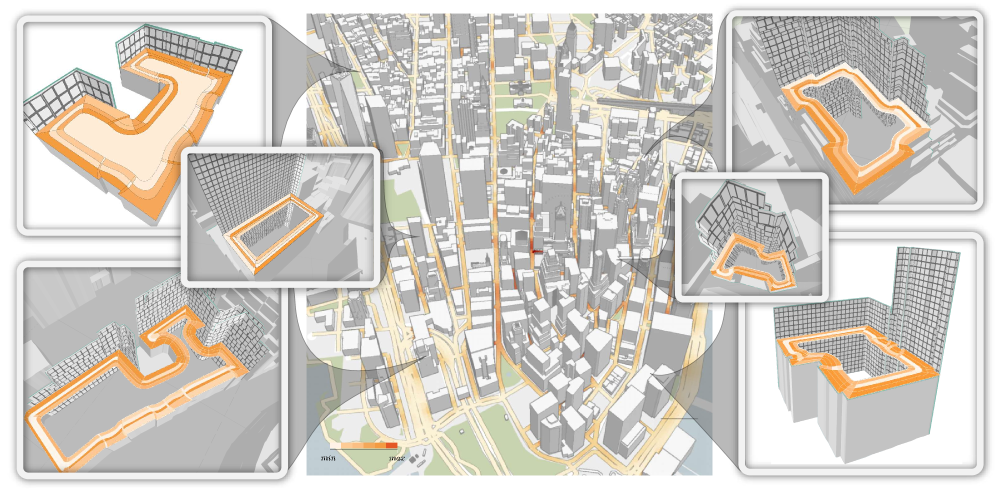
The visualization of temporal data on urban buildings, such as shadows, noise, and solar potential, plays a critical role in the analysis of dynamic urban phenomena. However, in dense and geographically constrained 3D urban environments, visual representations of time-varying building data often suffer from occlusion and visual clutter. To address these two challenges, we introduce an immersive lens visualization that integrates i) a view-dependent cutaway de-occlusion technique and ii) a temporal display derived from a conformal mapping algorithm. The mapping process first partitions irregular building footprints into smaller, sufficiently regular subregions that serve as structural primitives. These subregions are then seamlessly recombined to form a conformal, layered layout for our temporal lens visualization. The view-responsive cutaway is inspired by traditional architectural illustrations, preserving the overall layout of the building and its surroundings to maintain users’ sense of spatial orientation. This lens design enables the occlusion-free embedding of shape-adaptive temporal displays across building facades on demand, supporting rapid time-space association for the discovery, access and interpretation of spatiotemporal urban patterns. Guided by domain and design goals, we outline the rationale behind the lens visual and interaction design choices, such as the encoding of time progression and temporal values in the conforming lens image. A controlled user study compares our approach against conventional juxtaposition and x-ray spatiotemporal designs. Results validate the usage and utility of our lens, showing that it improves task accuracy and completion time, reduces navigation effort, and increases user confidence. From these findings, we distill design recommendations and promising directions for future research on spatially-embedded lenses in 3D visualization, urban analytics, and related domains.
Authors
Roberta Mota, University of Calgary, Canada
Julio D. Silva, University of Calgary, Canada
Fabio Miranda, University of Illinois, Chicago, USA
Usman Alim, Department of Computer Science, University of Calgary, Canada
Ehud Sharlin, Department of Computer Science, University of Calgary, Canada
Nivan Ferreira, Centro de Informática, Universidade Federal de Pernambuco, Recife, Brazil
Comentários desativados